He is often considered one of the most famous of the pin-up artists, and as one of the pioneers of airbrush art.
Numerous Vargas paintings have sold and continue to sell for tens of thousands around the world.
**As a side note – you will find many of them in posts on this blog. To access a huge collection of’ 100s of Vargas’ work go HERE…**
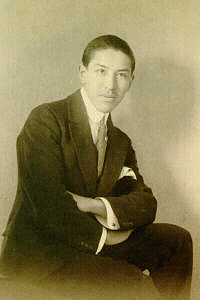
Alberto Vargas was born on February 9, 1896, in Arequipa, Peru and died on December 30, 1982 (age 86 years), in Los Angeles, CA.
He was married to Anna Mae (m. 1930–1974) and his parents were successful Peruvian photographer Max T. Vargas and Margarita Vargas
He was active mostly as an artist from the 1930s through the 1970s.
One of his last pinup models was the actress Bernadette Peters in 1980.
INFLUENCERS ON VARGAS’ ART
Alberto Vargas moved to the United States in 1916 after studying art in Europe, particularly in Zurich and Geneva, prior to World War I.
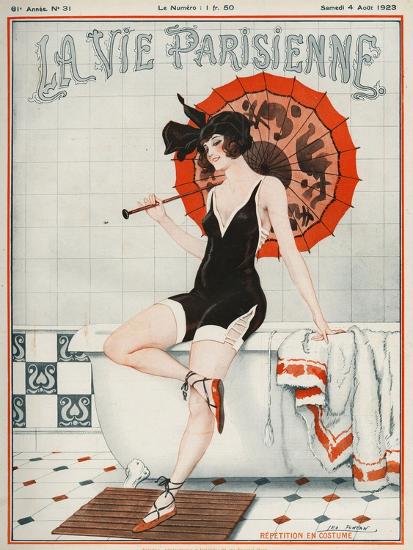
While Alberto Vargas was in Europe he came upon the French magazine La Vie Parisienne, with a cover by Raphael Kirchner. Which Vargas said was a great influence on his work.
Raphael Kirchner (5 May 1875 – 2 August 1917) was an Austrian artist, principally a portrait painter and illustrator best known for Art Nouveau and early pin-up work.
Especially in picture postcard format.
His work served as an early inspiration to Peruvian painter Alberto Vargas.
Vargas’ early career in New York included work as an artist for the Ziegfeld Follies and for many Hollywood studios.
Kirchner’s work on the cover of La Vie Parisienne…
MOST FAMOUS VARGAS WORKS
Ziegfeld hung his painting of Olive Thomas at the theater.
She was thought of as one of the earliest Vargas Girls.
Vargas’ most famous piece of film work was the poster of the 1933 film The Sin of Nora Moran.
This work portrays a near-naked Zita Johann in a pose of desperation, bearing little resemblance to the real actress.
The poster is frequently named one of the greatest movie posters ever made.

See below…

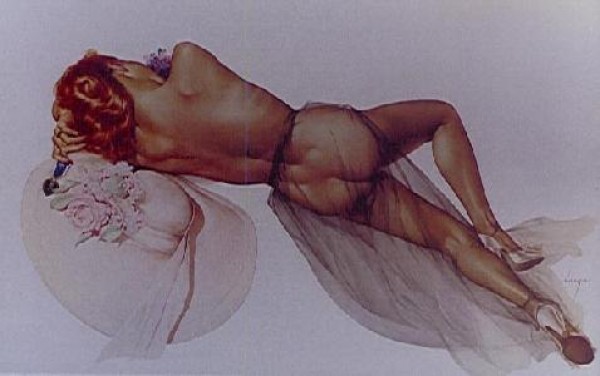
Alberto Vargas became famous in the 1940s.
He’s known as the creator of iconic World War-II era pin-ups for Esquire magazine the “Vargas Girls.”
Between 1940 and 1946 Vargas produced 180 paintings for the magazine.
THE PLAYBOY CONNECTION
Then in 2004, Hugh Hefner decided to showcase Vargas’ work which catapulted his fame and recognition even more, albeit, posthumously.
Hugh Hefner, the founder and Editor-in-Chief of Playboy, who had previously worked for the same magazine Vargas did – Esquire – wrote this:
“The US Post Office attempted to put Esquire out of business in the 1940s by taking away its second-class mailing permit. The Feds objected, most especially, to the cartoons and the pin-up art of Alberto Vargas. Esquire prevailed in the case that went to the Supreme Court, but the magazine dropped the cartoons just to be on the safe side.” – Hugh Hefner
A legal dispute with Esquire over the use of the name “Varga” resulted in a judgement against Vargas.
He struggled financially until 1959 when Playboy magazine began to use his work. Over the next 16 years he produced 152 paintings for Hef and the gang at Playboy magazine.
After that, Vargas’s career flourished and he had major exhibitions all over the world.
Thank you for your interest in The Body House’s content!
ALL Links – https://linktr.ee/bodyhouse1
Contact: thebodyhouse.biz@gmail.com
Find So Much More on Substack
at The Old Hollywood Newsletter!
Try these suggestions from Susan Bratton…
Relationship SAVING HUG – Soulmate Embrace {FREE eBook} – https://bit.ly/32vEbzQ
Relationship Magic – Free eBook – https://bit.ly/2ZDutcW
Taoist Sex Technique
Don’t Forget to Get That Beautiful Mug on a Mug!