The below article is from a fellow writer and narrator. He also has extensive experience working in the movie industry as a cinematographer and sound engineer. So I consider him a voices of Pre-Code Hollywood (Not that he’s that old, but old enough to know about these things).
He goes by the name Dom Jonson. He is the producer behind HEAT Audiobooks which creates and distributes immersive erotic audiobooks. These have multiple voices, music and background sound FX. If you like your audio erotica on the realistic side, well, check it out.
In 1929, silent movies began to talk. It was crude, but audiences loved hearing the actors talk and the music that was played. They loved the fact that they were fully immersed in the movie.
They were right there with their silent film stars who were no longer silent.
The “talkies” was that significant period between 1929 and 1934.
Now —- what do you think happens when you get a bunch of artists together, give them a voice and say, “Make something entertaining!”
The result is very much what you get in 1933’s King Kong.
Which is exactly WHY the Hays Code was created and enacted.
The powers-that-shouldn’t-be were not about to have Hollywood presenting thought provoking scenes that would leave the general public asking questions.
So without further adieu, here’s Dom’s take on PRE-CODE Hollywood…
————————————————————————————————-
“ Exploit yourself ! Go to some big city, where you will find opportunities. Use men. Be strong. Defiant. Use men to get the things you want! ”
If you were to watch a movie on Netflix tonight and in a movie you heard a young impressionable woman being given this advice, would it make you think… ‘Whow… Can they even say that?’

If you are shocked, that’s because you were born after 1934, when Hollywood developed the Hays Code to clean up movies and Make America Moral Again.
However, before 1934, movies with scenes like this were common. This was because they were very profitable–even after the financial collapse of 1929, people still wanted to see them.
Theses movies spoke to audiences. It was because they were ‘non-fiction’ stories to many–not rose colored fake fiction. They reflected what real people experienced in real life.
Stories commonly explored the power dynamics between men and women where sex is a major bargaining chip between the characters.
This brief but hugely profitable period in Hollywood, is known as the Pre-Code era (1929-1934).
During these, the Pre-Code years, Hollywood experimented in new unexplored, unrestricted, and some said “heathen” directions.
They flirted with taboo subjects like:
- divorce
- revenge
- infidelity
- violence
- criminals portrayed in a positive light
- extramarital romance leading to real love
- married couple sleeping in one bed
- open relationships
Sometimes even gratuitous nudity–no one complained. (see Tarzan below)

So, in response to an outcry by religious and morality leaders wanting to protect the public they demanded there be a way to get Hollywood to ‘self-police.’
That’s when the ‘Motion Picture Producers and Distributors of America’ (MPPDA) developed the Hays Code.
Beginning in 1934, The Hays Code kicked off. It was said to be a ‘self-imposed.’ However, it was enforced by others who could prevent distribution. And they did.
What movies had ‘the public’ up in arms you ask?
Stunning cinematic achievements which surprise audiences today as to how progressive they were towards women (who didn’t die at the end of the movie for not being a good girl).
Red Headed Woman (1932)
- A red-haired harlot homewrecker (Jean Harlow), breaks up her boss’s marriage. Then sins her way to financial success, and makes good in the world. Can’t let that get around.

Baby Face (1933)
- The sexual escapades of a young woman, Lily (Barbara Stanwyck). She uses her body and her sexuality to help her climb the social ladder, sleeping her way to the top of a banking empire.

Frankenstein (1931)
- Morality issues with this story had many church leaders up in arms with flaming torches. They objected to the phrase by the doctor who says, “Now I know what it feels like to be God.” There is some violence in this movie too.

The Public Enemy (1931)
- Tom Powers (James Cagney) rises up from a poverty-stricken slum to become a thief, bootlegger and cold-blooded killer (and rubbed a grapefruit roughly into a woman’s face — Jean Harlow).

Tarzan (1932)
- Maureen O’Sullivan (Jane) swimming ‘very’ nude underwater with Tarzan leading to a love scene.
Too many damn leaves in the jungle, however.

KING KONG (1933)
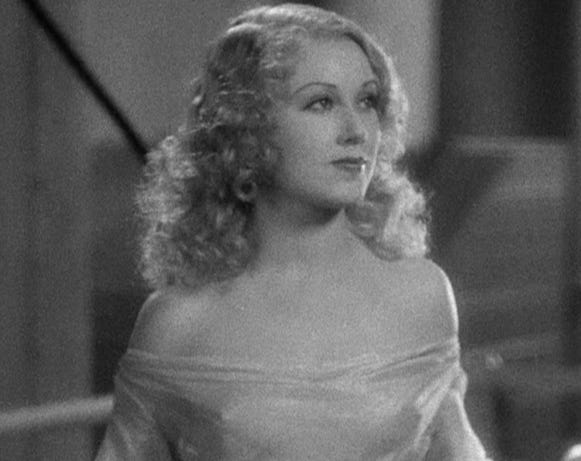
One of the best remembered Pre-Code movies.
This blockbuster was the Star Wars of its day; full of incredible never before seen non-stop action sequences and loaded with ‘how did they do that’ and ‘is that real’ special effects.
Stop-motion animation was not new, but the way it was used in this movie was, and it was incredibly real looking (to a 1932 audience).
The movie was incredibly profitable for RKO Pictures and made a star and cultural pop-icon out of the lead actress FAY WRAY.
One of the movie’s most memorable scenes involves the giant gorilla, Kong, in his jungle lair holding the ‘beauty’ in one hand (full-frontal to the camera). He is slowly, carefully stripping her dress off of her with his other hand.
Yes, that was the real live action Fay Wray. Slowly, layer by layer, having her body exposed to the audience… not a stop motion animation puppet.
Watch the full 1933 version of King Kong on Substack here…
You may ask, ‘Why was the female lead character, Ann Darrow, running around the wilds of a dark jungle in a spotless white and tan dress?’
Well, to be fair, it was frowned upon for women to wear trousers. That was; until the 1940’s (with women working in factories supporting the war effort).
Women wearing pants was considered too revealing–—the very idea of being able to see between a woman’s legs.
‘Please…’ you may say, but even as recently as several years ago (2020) there was a moral outcry over Stretch Pilates/Yoga pants as being too revealing.
Please —> Free the breast. Free the nipple. Free the labia.
Well, Kong wanted to see more of his beauty too.. and wasn’t waiting for consent.
What movie goers didn’t really appreciate was the complexity of producing one of old Hollywood’s most memorable and sensuous scenes.
Without ‘geeking out’ too much–yes, that was the real Fay Wray being stripped out of her dress. Not a fake stop-motion puppet.
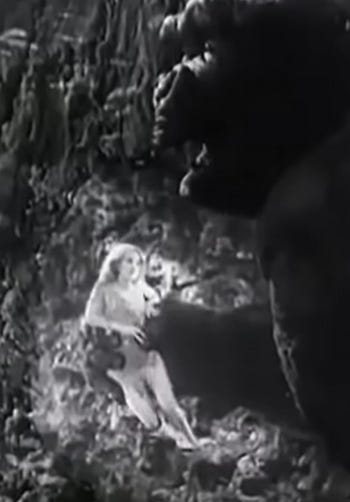
This scene required two separate filming setups; one was a live action background plate, the second was a foreground ‘stop-action’ sequence later shot on top of the background plate.
For the live action sequence; wires were pulled (to be invisible to the eye and camera) which, one by one, removed pieces of dress, off beauty’s body to make it look like her dress was being ‘torn’ away piece by piece.
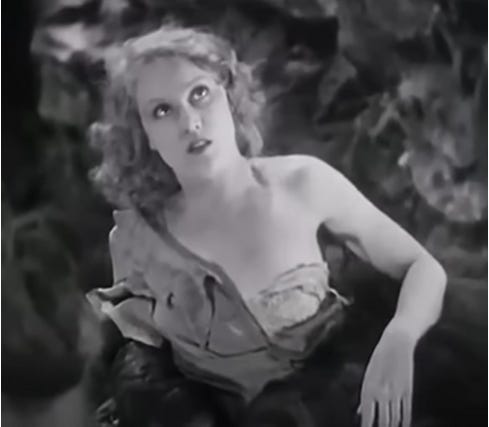
Think of it; on the set there are all these men around the half naked actress. They’re working the wires and the mechanical fingers on the ape hand (opening and closing) to make it look alive. Not to mention all the grips and electricians working the lights on the stage.
Got to love an audience.
This live-action ‘element’ is all filmed in real-time; meaning the actress screams, flails her arms wildly, and tries to wiggle free from Kong’s big hand. Actually, she never stops moving so the audience knows she’s real (not a puppet).
Then, on a separate movie set on another day, a large screen is set up. That live-action scene is of the beauty having her dress ripped off. It’s now projected onto that screen and moved forward one frame at a time.
While, in front of the screen, right in front of the camera to make it look big, a stop-motion half-size Ape-puppet is animated. This makes it look like it is interacting with the beauty in its other hand.
To the camera; the Ape’s hands and arms are now ‘visually’ seen moving as one animal.
We then watch as the giant ape gently fingers beauty’s breasts and body (I would). It is this stop-motion animation of Kong in front of the live-action of his beauty that ‘sells’ the shot and the ‘suspension of disbelief’ muscle is not needed.
Put together in the camera; it looks like the foreground stop-motion hand and Kong are really tearing the dress off the wiggling live-action beauty who’s being held against her will in Kong’s other hand.
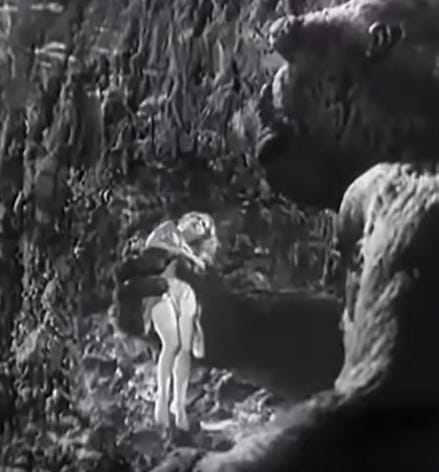
There is no compositing of negatives. This is all ‘in-camera’ and helps keep the final film sharp–not grainy. So this shot will inter-cut perfectly with the movies main live action scenes.
This special effects technique is used throughout the movie, providing depth and stunning realism to great effect. To good effect, actually.
This scene and a number of others will be removed. Edited out of the movie when it is re-released in 1938, per the Hays Code.
Here is a quick youtube film that shows all the pre-code Hollywood scenes that DIDN’T make it in the Post-code 1938 remake of King Kong. Interesting…
Find Dom Jonson’s Substack – HEAT Audiobooks HERE..
If you liked this post you might also like these:
Fay Wray Featured in Oct/2025 Issue
Audiobook Review of The Best Erotic Short Stories of 2025
8 Not So Trivia Tidbits of the Vintage Movie Biz
And as always —→ I wish you a very sensual day, Dyann. xoxo
Thank you for your interest in Celebrating Vintage Sensuality.
CONTACT DYANN: thebodyhouse.biz@gmail.com
ALL Links – https://linktr.ee/bodyhouse1