Human beings have a tendency to find a hero and elect a leader.
We want someone to be the guy to have been the FIRST to built something that the rest of us continued on the back of.
The truth – in every case – is that it’s a group effort.
There are always connections that feed the life blood of foundational building.
It’s easier to remember and appreciate that process when we attach it to one person.
It’s with this in mind that I say — Hollywood did not become the motion-picture capital of the world because of one director or one studio.

THE TRUTH IS…
It was built by a succession of filmmakers, actors, producers, studio founders, writers, technicians, and business people who arrived in Southern California at different stages and transformed a small agricultural community into an international entertainment industry.
1881–1909 — Harrison Gray Otis – The Los Angeles Times
Harrison Gray Otis became editor of the Los Angeles Times in 1882 and helped turn it into a powerful regional newspaper.
Its reporting, editorials, advertising, and influence over civic affairs made it an important institution in Southern California’s growth.
His son-in-law, Harry Chandler, worked within the Times organization and became increasingly important in the newspaper’s business and real-estate interests.
Chandler would go on later to have serious influence on Hollywood as an early real estate developer.
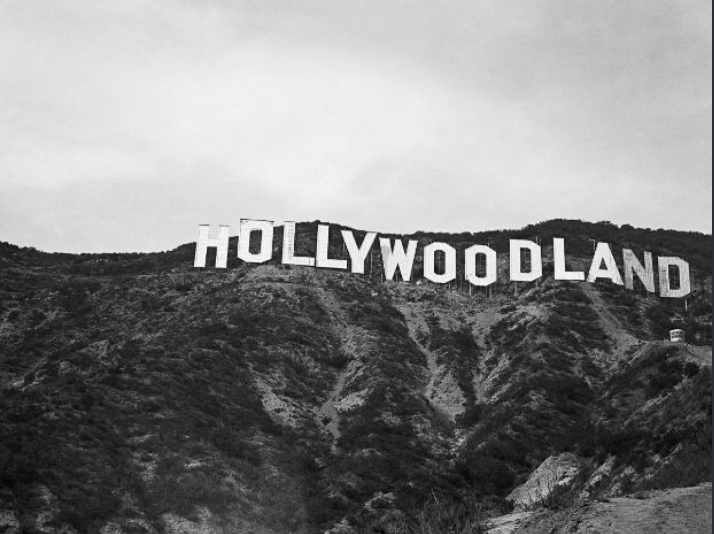
Chandler was the man responsible for putting up the original HOLLYWOODLAND sign and building up the area for commercial interests.


1903 — William Randolph Hearst establishes the Los Angeles Examiner
Hearst launched the Los Angeles Examiner in December 1903.
This is his second newspaper. In March 1887, Hearst was officially given control of the San Francisco Examiner.
The San Francisco Examiner was a failing newspaper his father, George Hearst had been given as payment for a gambling debt.
His father was a wealthy mining magnate and had little interest in running a newspaper. So, he gave it to his son William Randolph who seemingly was made for newspaper publishing — and exploded it into a success.
With the formation of the LA Examiner, Hearst had created a powerful competitor to the LA Times.
Hearst’s importance to the movie industry extended well beyond local newspaper circulation.
His organization developed entertainment publicity – Hearst was a forerunner and pioneer in this arena.
His media interests eventually included: newsreels and motion-picture production.

The Groundwork: 1900–1909
Before Hollywood became a film capital, Los Angeles was building the infrastructure, population, publicity networks, and commercial environment that made it possible.
1900–1903 — Hollywood becomes a planned community
Key figures: H. J. Whitley and Harvey Henderson Wilcox
The Hollywood Hotel opened in 1902 and became a prominent landmark.
Developers promoted the area as an attractive place to live, while streetcar connections linked it with the expanding Los Angeles region.
Hollywood was still primarily a residential and agricultural community.

Wilcox – a man who was a shoemaker turned real estate developer and wheelchair bound from the age of 13 – REGISTERED THE NAME HOLLYWOOD.
This was a surprise.
He registered the name Hollywood for his own estate west of the city of Los Angeles in 1887.
Hollywood would later became an incorporated municipality on November 14, 1903, following a local election where residents voted 88 in favor and 77 against.
Wilcox (born in New York in 1932 – died March 19, 1891) contracted poliomyelitis in 1845 when he was about 13 years old and used a wheelchair the rest of his life.
He apprenticed as a shoemaker, eventually married and then got into politics. At some point he gave up shoe-making to deal in real estate which is how he came to register the name Hollywood for his property.
Harvey Wilcox died at the approximate age of 59, in Los Angeles, with more than $100,000 (approximate,y 2.3 million dollars today).
Originally buried beside his mother in Rosedale Cemetery, his body was eventually moved on November 13, 1922, to Hollywood Forever Memorial Park where he is interred next to his second wife, Ida.

1907–1910 — H. J. Whitley
A real-estate developer and civic promoter, Whitley helped develop Hollywood as a residential and commercial community before the film industry took hold.
His importance is as a builder of the town that filmmakers would later occupy, rather than as a film producer.

FAUX VINTAGE ADS IN THE OLD HOLLYWOOD VAULT
1910 — 1931 —- D. W. Griffith
Griffith brought one of his Biograph Company troupe west from New York, including actors such as Mary Pickford.
His first film there was In Old California (1910). The production demonstrated that the area’s scenery and weather could support film production beyond the East Coast.
Griffith is considered one of the most influential figures in the history of the motion picture. He pioneered many aspects of film editing and expanded the art of narrative film.
He had close associations with actors Mary Pickford, Lillian Gish, Blanche Sweet, and cinematographer G. W. Bitzer who worked on In Old California.

1911 — David Horsley and William Horsley
The Horsley brothers brought the Nestor Film Company to Hollywood.
David and William Horsley founded the compay in 1909 as the West Coast unit of the Centaur Film Company.
In October 1911, Nestor established a studio in a former tavern at Sunset Boulevard and Gower Street.
It became the first permanent motion-picture studio in Hollywood.
Director Al Christie was another important early figure in the company’s productions.

1910–1912 — William Selig
Selig’s Chicago-based company established production facilities in the Los Angeles area, particularly Edendale.
The 1910 silent short film The Wonderful Wizard of Oz, was produced by William Selig’s Polyscope Company. It was directed by Otis Turner.
Selig helped develop studios across greater Los Angeles, not exclusively within Hollywood’s boundaries.

1912 – Krotona Theosophical Society
The Krotona Theosophical Society was established in 1912 in the Hollywood Hills of Los Angeles by Albert P. Warrington.
This is historically significant because California became and is still the leader in alternative and occult religions and spiritual practices. Many Hollywood movie industry professionals were devout in their occult practices and believed – in large part – their rituals and ceremonies kept their careers alive.
This part of Hollywood will continue to be discussed here at The Old Hollywood Newsletter as I believe this to be a key component in the state of today’s entertainment industry and indeed — our entire society.
Find the post on the founding of Krotona Theosophical Society here…

1912 — Carl Laemmle
Laemmle helped build the independent production movement that challenged the powerful Motion Picture Patents Company, commonly called the Trust.
Universal Pictures was incorporated as the Universal Film Manufacturing Company in New York City on April 30, 1912.
This was through a merger of several independent film companies, including interests associated with the Horsley brothers’ Nestor Film Company.
The move toward large-scale production was underway.

1913–1914 — Cecil B. DeMille, Jesse L. Lasky, and Samuel Goldwyn
DeMille arrived in California in December of 1913 with a production company organized around Lasky’s feature-film venture.
DeMille and Oscar Apfel began shooting The Squaw Man on December 29, 1913.
It was completed in January 1914 and became the first feature film made in Hollywood.
Its production site was a converted barn near Vine Street and Selma Avenue.

FAUX VINTAGE ADS IN THE OLD HOLLYWOOD VAULT

1914–1919 —- The Early Stars of Hollywood
This is the period when Hollywood began attracting established stage performers.
1913–1915 — Mary Pickford
Pickford had already worked with Griffith at Biograph in New York, but her growing success in California helped establish her as a commercial asset.
Her popularity demonstrated that audiences would follow individual performers, not merely film companies.
She later became a producer and one of Hollywood’s most influential business figures.

1912–1915 — Mack Sennett
Sennett established Keystone Studios in the Los Angeles area in 1912.
It helped turn slapstick comedy into a major film genre and launched performers such as Charlie Chaplin, Mabel Normand, and the infamous Keystone Cops.
His career illustrates why the early industry cannot be understood through dramatic feature films alone.

1914 – 1919 Charlie Chaplin
At 19, Charlie Chaplin was signed to the British Fred Karno company, which brought him to the United States.
In 1914, Chaplin gained widespread popularity through his appearances in Keystone Studios films. Soon after, he introduced the world to his Tramp persona.
He moved to Essanay Studios, where Chaplin continued to grow as a performer and artist.

1919 – United Artists is formed
United Artists (UA) was founded on February 5, 1919 by Charlie Chaplin, D. W. Griffith, Mary Pickford and Douglas Fairbanks.
It was a venture premised on allowing actors to control their own financial and artistic interests rather than being dependent upon commercial studios.

THANK YOU FOR CELEBRATING
OLD HOLLYWOOD GLAMOUR &
VINTAGE SENSUALITY WITH US
Contact: thebodyhouse.biz@gmail.com
Don’t Forget to Get That Beautiful Mug on a Mug!