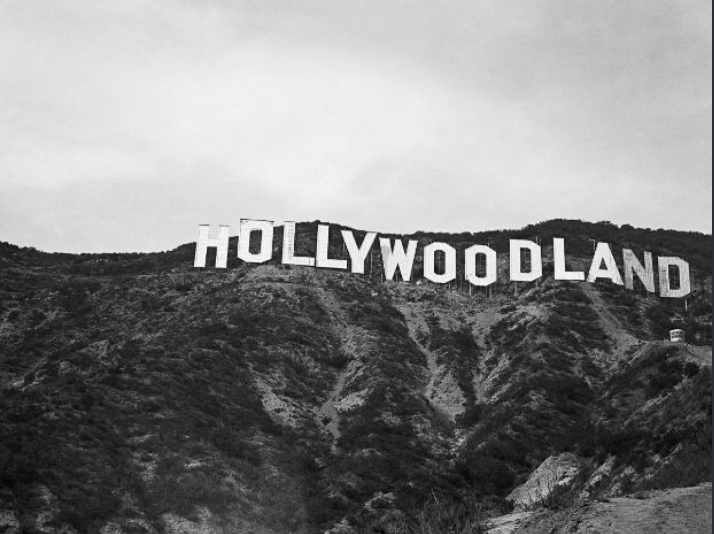
Long before Hollywood became the mecca of the entertainment industry, the hills above Los Angeles were home to a planned spiritual community devoted to Theosophy.
Theosophy can be broadly described as being a spiritual philosophy that encompasses comparative religion, occult philosophy, education, art and the investigation of what its founders considered the hidden dimensions of human existence.
In 1912, this society built a compound for the learning and exploration of this mixed bag of philosophies in the Hollywood Hills.
They called it Krotona.

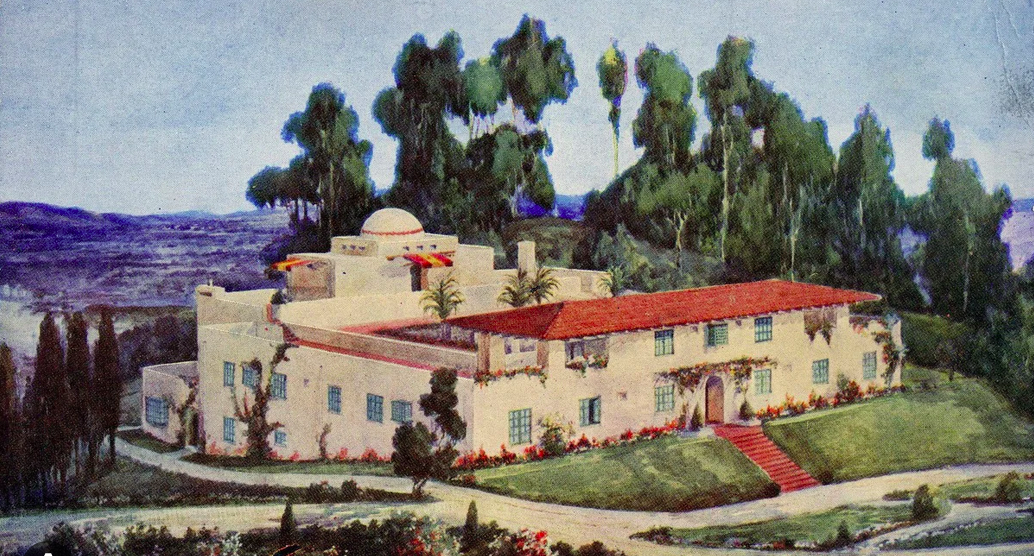
This building is also known as the Grand Temple of the Rosy Cross
For roughly twelve years, from 1912 to 1924, Krotona occupied a remarkable position in the Hollywood Hills—close enough to the emerging film industry to attract actors, artists and other creative figures, but deliberately removed from the noise and commercialism of Los Angeles.
Eventually, the Theosophists realized that Hollywood was expanding and they would soon be over run at some point. So, they moved to 74 miles north, to Ojai, California.
THE IDEA BEHIND KROTONA
Krotona grew directly out of the international Theosophical movement founded in the nineteenth century by Russian-born religious mystic Helena Petrovna Blavatsky (born August 12 1831 – died May 8, 1891).
By the early twentieth century, Theosophy had developed into a broad intellectual and spiritual movement.
Blavatsky was one of the first in ‘modern’ times (1950-2025) to blend and compare religion, philosophy, science, mysticism, reincarnation, hidden laws of nature and the evolution of human consciousness together into a spiritual philosophy.
One of Theosphy’s central ideas was that there exists an underlying spiritual unity behind the world’s religions and cultures.
A picture of H.P. Blavatsky below…

Bringing It Out of Books…
An American Theosophist and attorney, Albert Powell (A.P.) Warrington, wanted to take Blavatsky’s ideas out of the realm of books and lectures and create an actual community in which people could practice living them.
In 1906, Warrington presented Annie Besant with his proposal for a community he called the Crotona Institute and Fellowship of Crotona.
***The name referred to Crotona in southern Italy, traditionally associated with the school of the ancient Greek philosopher Pythagoras.***
It’s important to note that Annie Besant – in 1889 – converted to the doctrines of the Helena Blavatsky – and became a cofounder of the Theosophical Society.
Besant was also an early advocate of birth control, and in the late 1880s she became a prominent Fabian socialist under the influence of George Bernard Shaw.
A picture of Annie Besant below….

A.P. Warrington envisioned something considerably broader than a religious compound.
His proposal included communal life, education, study, arts, health, retreats and the cultivation of character. The purpose was to create an environment in which intellectual and spiritual development could become part of everyday life.
Annie Besant approved the project.
Besant influence can not be underestimated as one of the most important figures in the international Theosophical Society. Besant, at the time, was the Outer Head of the Esoteric Section of Theosophy. This was the more inward and spiritually focused organization within the Theosophical movement.
Warrington was Besant’s representative in the United States.
*** So, another important point — Although, Warrington was the practical founder and driving force behind the American Krotona project, it existed within a much larger international Theosophical structure headed by Besant.***
WHY HOLLYWOOD?
The location they chose is one of the most fascinating parts of this story.
After considering possible locations in Virginia, Oklahoma, Texas, New Mexico, California and even Mexico, the organizers eventually selected land in Beachwood Canyon in the Hollywood Hills.
In March 1912, the Krotona Organization Committee acquired approximately ten acres of the Hastings estate.
The location offered exactly what they wanted — natural beauty, relative isolation and access to the growing population of Los Angeles.
Warrington wanted Krotona to welcome people to lectures, education, performances and other activities. The complex eventually expanded beyond the initial ten acres.
It included residential buildings, lecture and educational facilities, a library, gardens, a vegetarian cafeteria, offices and the remarkable Grand Temple of the Rosy Cross, associated with another esoteric organization — The Rosicrucians — operating within the Krotona environment.
The community became a kind of spiritual and intellectual village.
WHAT HAPPENED IN KROTONA?
The community offered instruction and lectures in subjects that were then and even today, sound like an unusual combination.
Look at this list;
- Theosophy
- Comparative religion
- Philosophy
- Science
- Psychology
- Drama
- Art
- Vegetarianism
- Human evolution
- Occult philosophy
The first Krotona summer school began in July 1912, attracting roughly 80–90 students.
The community also maintained publishing and printing activities.
The Theosophical Book Concern moved from Chicago to Hollywood for a time, establishing printing, binding and distribution operations there.
Krotona therefore functioned simultaneously as:
- a spiritual community
- a school
- a lecture center
- a retreat
- a publishing operation
- a library
- an arts center
- a residential colony
- and a meeting place for people interested in esoteric subjects.
THE PEOPLE OF KROTONA
The residents and associates are part of what makes Krotona particularly interesting from a Hollywood-history perspective.
Among those associated with the community were A. F. Knudsen, Eleanor Broenniman, Carlos Hardy, Fritz Kunz, Max Wardall, Virginia Baverstock, C. F. Holland, Isabel Holbrook, Grace Shaw Duff, Marie Poutz and George H. Hall.
Some were wealthy patrons. Others were writers, editors, teachers, administrators, lawyers or intellectuals.
MARIE RUSSAK: THE WOMAN WHO CONNECTED KROTONA TO HOLLYWOOD
One of the most intriguing figures in the entire story is Marie Russak Hotchener.
Russak was a Theosophist, lecturer, writer, musician and occultist who became deeply involved in the development of Krotona.
She was also an amateur architect.
Her architectural work helped give the Hollywood colony its extraordinary appearance, incorporating Moorish, Indian, Mission Revival and other exotic influences.
Her most famous surviving house is Moorcrest. ←—This is where the story moves directly into Hollywood.
Moorcrest was rented by Charlie Chaplin.
Later it was purchased for the family of Mary Astor, the young movie star.


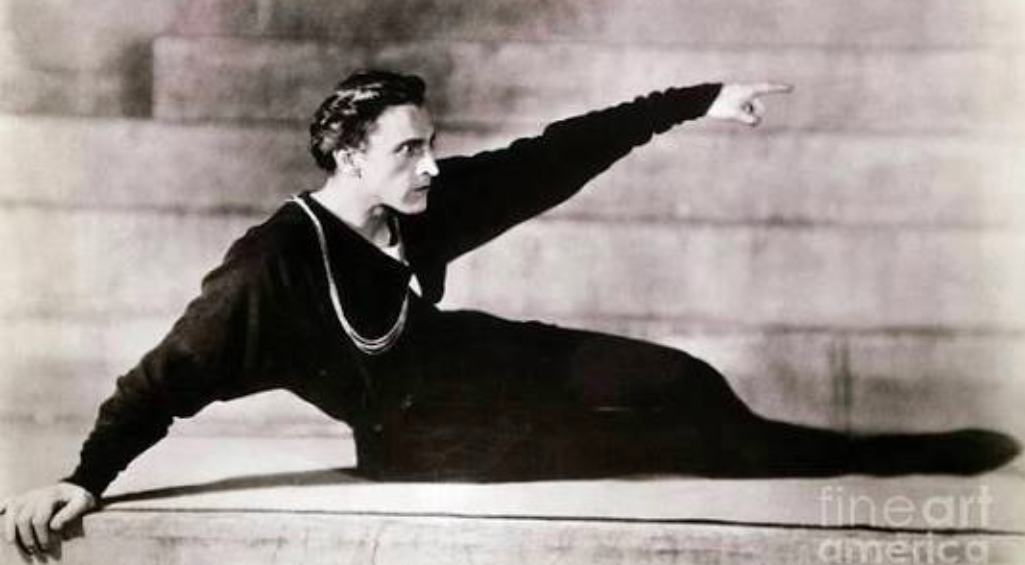
The Astor family was friendly with the Hotcheners, and Mary’s relationship with actor John Barrymore brought another important Hollywood connection into the Krotona circle.
**** Today the mansion is apparently owned by SNL comedian Andy Samberg and his wife. Click on the link to be taken to incredible pics of the inside of Moorcrest.****
Henry Hotchener eventually became Barrymore’s business manager, while Marie Russak became associated with Barrymore and members of the Hollywood community through astrology and Theosophical interests.
CHARLIE CHAPLIN AND MARY ASTOR
The Chaplin/Astor connection deserves special attention. This is where the Krotona Community really starts to intersect with Hollywood.
Moorcrest was designed by Marie Russak Hotchener and completed around 1921.
Charlie Chaplin lived there for a time.
After Chaplin, the house was acquired by the Langhanke family, whose daughter was the young actress Mary Astor.
Astor’s family was not itself Theosophist, but the family became friendly with the Theosophical community through the Hotcheners.
This put one of Hollywood’s most famous young actresses directly into the orbit of Krotona’s Theosophical circle.
Astor’s association with John Barrymore strengthened the connection further.
The resulting chain is remarkable:
Krotona → Marie Russak Hotchener → Moorcrest → Charlie Chaplin → Mary Astor → John Barrymore → Henry Hotchener.
It is one of the clearest examples of how the supposedly separate worlds of occultism and Hollywood actually overlapped socially in early Los Angeles.


THE ARCHITECTURE WAS PART OF THE THEOSOPHY PHILOSOPHY
Krotona was not architecturally ordinary.
The founders of Theosophy wanted the physical surroundings to reflect the spiritual and intellectual ambitions of the community.
Architects associated with the development included Arthur and Alfred Heineman and the firm of Mead & Requa.
The buildings incorporated Moorish, Spanish, Mission, Islamic and other exotic architectural elements.
The Grand Temple of the Rosy Cross was particularly striking.

The result was something that looked almost like a piece of another civilization transplanted into the Hollywood Hills.
Krotona’s founders believed that environment mattered—that architecture, gardens, art, education and daily life could all contribute to the development of consciousness.
THEN HOLLYWOOD CHANGED
What few understood at the time was just how fast Los Angeles was growing.
The surrounding countryside disappeared. Residential development moved into the hills. Los Angeles became increasingly crowded.
Hollywood became the center of the rapidly expanding motion-picture business.
With expansion like this comes business which means more costs and more taxation.
For example, operating costs and property taxes increased.
The Krotona organization began to have had financial difficulties. The publishing operation was more economically suited to Chicago than L.A.
There were internal disagreements about the relationship between the American Theosophical Society and the Esoteric Section, as well as, about the various other esoteric organizations operating within the Krotona environment.
Eventually, they made the decision to leave.
WHY OJAI?
Ojai offered almost the opposite environment to the newly bustling Los Angeles.
Ojai, was 74 miles north in a quiet area of California with mountains, orchards, open land and rural settings.
Probably most importantly, Theosophists were already there.
Warrington had learned about Ojai through Theosophists Mary Gray and Robert Walton, both of whom had established homes in the valley and encouraged the move.
Then something happened that made Ojai even more important to the Theosophical movement.
In 1922, Jiddu Krishnamurti, an Indian spiritual leader, writer and lecturer and his brother Nitya visited Ojai.
****Jiddu Krishnamurti had been adopted by Theosophists when he was young and was heavily influenced by their philosophies.****
Warrington arranged for the brothers to stay at the Krotona Community in Ojai and they became strongly attracted to the valley.
Krishnamurti would eventually maintain a home there for the rest of his life.
For the Theosophists, Ojai increasingly appeared to possess precisely the qualities they had originally wanted for Krotona.
Warrington purchased the 118-acre Kerfoot Ranch, on the hill that would become the new Krotona property.
The move began in 1924.
From there the legacy of Theosophy continues where both Krishnamurti and Hollywood become more heavily embedded in this fascinating philosophy.
THANK YOU FOR YOUR INTEREST IN OLD HOLLYWOOD GLAMOUR AND VINTAGE SENSUALITY AS WE PULL BACK THE CURTAIN ON THE MYTHS
Contact: thebodyhouse.biz@gmail.com
Don’t Forget to Get That Beautiful Mug on a Mug!